Showing posts with label Rock Art. Show all posts

Arizona Petrified Forest and some more Petroglyphs

July 22, 2011 | | 0 comments

I made it out of New Mexico today and into Arizona, took a stop at Petrified Forest National Park and a couple of other cool places. Check out the photos...

Welcome to Arizona!
The southern part of the painted desert in Petrified Forest National Park. This one's for you, mom! :)
More painted desert.
And more...
And more...
They even have a pueblo site; Puerco Pueblo that has some petroglyphs. From the National Park Brochure..." Stories abound in the Petrified Forest. Evidence of ealy humand occupation is readily visible. Sites thoughout the park tell of human history in the area for more than 10,000 years (I'd say Pre-Clovis, Tressa). We do not know the entire story (as usual). But there were separate occupations, a cultural transition from wandering families to settled agricultural villages (just like we learned in New World Prehistory)-or pueblos-and trading ties with surrounding villages (like Chaco, etc.) Although evidence of these early people in the park fades about 1400 (as is with most of the pueblo sites, most likely due to extreme long-lasting drought), their story is still told by their dwellings, pot shards, and petroglyphs."
These were a bit harder to see and there was a large fence protecting the area. There was also a big sign that said "Bee's might be swarming in this area, proceed with caution"...

Feets.
It's interesting to see how these images are carved into areas of the rock that are blackened with patination (hehe-DJ). But thankfully, due to awesome preservation, they seem to last a while...I mean, there are also trees laying around in this area from the a Triassic forest, so...
I like the bird with the little guy in its mouth. I'd say this has something to do with the ubiquitous thunderbird myth, common in indigenous American cosmology. 
More petroglyphs.
Here is the small(ish) pueblo where adjacent to where the petroglyphs are located.
Apparently the rocks in the next photo are covered in petroglyphs. The sign said that it is one of the largest concentrations of images ever found. Saldly, I couldn't see any of them, and you couldn't even get close to the rocks, as Park Ranger Bob had already been bitching at some kids for climbing out on one of the rocks for a photo...
Petroglyphs at the Newspaper rock site...
Let me know if you can see any...
This is a part of the painted desert called the "tepees." The whole area reminded me of Badlands National Park and apparently, fossils turn up everywhere.
That's a really old, petrified tree. :) From the park's brochure..."This high, dry grassland was once a vast floodplain crossed by many streams. Tall, stately conifer trees grew along the banks. Crocodile-like reptilians, giant amphibians, and small dinosaurs lived among a variety of ferns, cycads, and other plants and animals known only as fossils today. The trees, Araucarioxylon, Woodworthia, Schilderia, and others, fell, and swollen steams washed them into adjacent floodplains. A mix of silt, mud, and volcanic ash buried the logs. This sediment cut off oxygen and slowed the logs' decay. Silica-laden groundwater seeped throught he logs and replaced the original wood tissues with silica deposits. Eventually, the silica crystallized into quartz, and the logs were preserved as petrified wood. Over the 225 million years since the trees lived, the continents moved to their present positions, and this region was uplifted. As a result the climate changed, and the tropical environment became today's grassland. Over time, wind and water wore away the rocks layers and exposed fossilized ancient plants and animals. The hills will yield more fossils as weathering sculpts the Painted Desert's soft sedimentary rock."
Remnants of a 225 million year-old forest.
From the park's brochure..."Petrified wood's varied colors came from minerals in the silica-saturated waters. Iron, carbon, manganese, and sometimes cobalt and chromium produced patterns and blends of yellow, red, black, blue, brown, white, and pink. Petrified wood is surprisingly heavy, weighing nearly 200 pounds per cubic foot, and its hardness is seven on a ten-point scale."


That's a really old dead tree....cool, huh? :D
I knocked on this one, and yes, they are very hard...haha!

Pretty huh? I was told that petrified wood is found throughout the world, but Arizona is really the only place one can find such specimen streaked with the brilliant colours you see here. I could've easily picked up this piece, as it was only a bit larger than my hand, but... (from the park's brochure...) "Do not take even the smalled piece of petrified wood from the park. Multiplied by the hundreds of thousands of visitors here every year, the small pieces stolen from the park can quickly amount to tons...It is illegal to collect or remove any petrified wood from the park. Samples of the same quality from the same deposits-but collected outside the park-may be obtained from nearby commercial sources. Petrified wood slabs are cut with giant, oil-cooled diamond saws. Then the are ground with silicon carbide grit to smooth the saw marks and roughness. This is followed by hours of polishing. Artisans fashion jewelry and other decorative objects from polished pieces." Conveniently, as soon as you leave the park, there are two rock shops that sell every piece of petrified wood (along with other rock shop extravaganza, even Pseudo-Navajo rugs made in India!) and many other of these places exist along the route leaving the park. And yes, I bought a few pieces and they are beautiful. :)
Some dinosaurs along Historic Route 66.
This is where I stopped for lunch. It was a lovely little spot on Route 66 that may or may not have had the best food in town...though I must say, the BLT I had was pretty awesome!
Just for proof. Yes, I did drive a bit on HWY 66. Another dream come true. :)
I didn't read much into this, but apparently NASA used the giant crater just outside of Flagstaff for some operations. I just wanted to see the crater...
This one is for you, Mom...as I know you always wanted to be an Astronaut. :)
The humongous meteor crater right outside of Flagstaff. This this was enormous...they said something about it being 2.5 miles wide...!!?!
And I would certainly believe it. The NASA base is located in the center and there is life-size image of an astronaut waving next to an american flag...they provided telescopes for proportion...I can't even see it in this image.
Maybe you can? :P
Finally, Hualapai Peak, 8, 417 feet at the tip-top. The town I'm staying in tonight, Kingman is just north of the peak and there are stunning views all around. :)
I'm going to Santa Barbara tomorrow to see some of the Chumash cave paintings also featured in my book, Painted Dreams by Thor Conway. Jack is an even happier man. More to come soon! Keep in touch! Peace and love to all.

Chaco Canyon

| | 0 comments

Rock art at Una Vida pueblo site. This was my first on-hand encounter with southwestern rock art and I almost peed myself with excitement.
Jack's a happy guy. :)
Chacoan beauty.
This is the great Kiva at Chetre Ketl with seating pits, vaults, and firebox intact. I again, almost peed on myself...to study this stuff in class is one thing, but to see it firsthand, is something extravagant.
Some smaller kivas at Chetro Ketl.
The great Kiva at Pueblo Bonito. :D
Jack is getting happier with every step into the canyon...
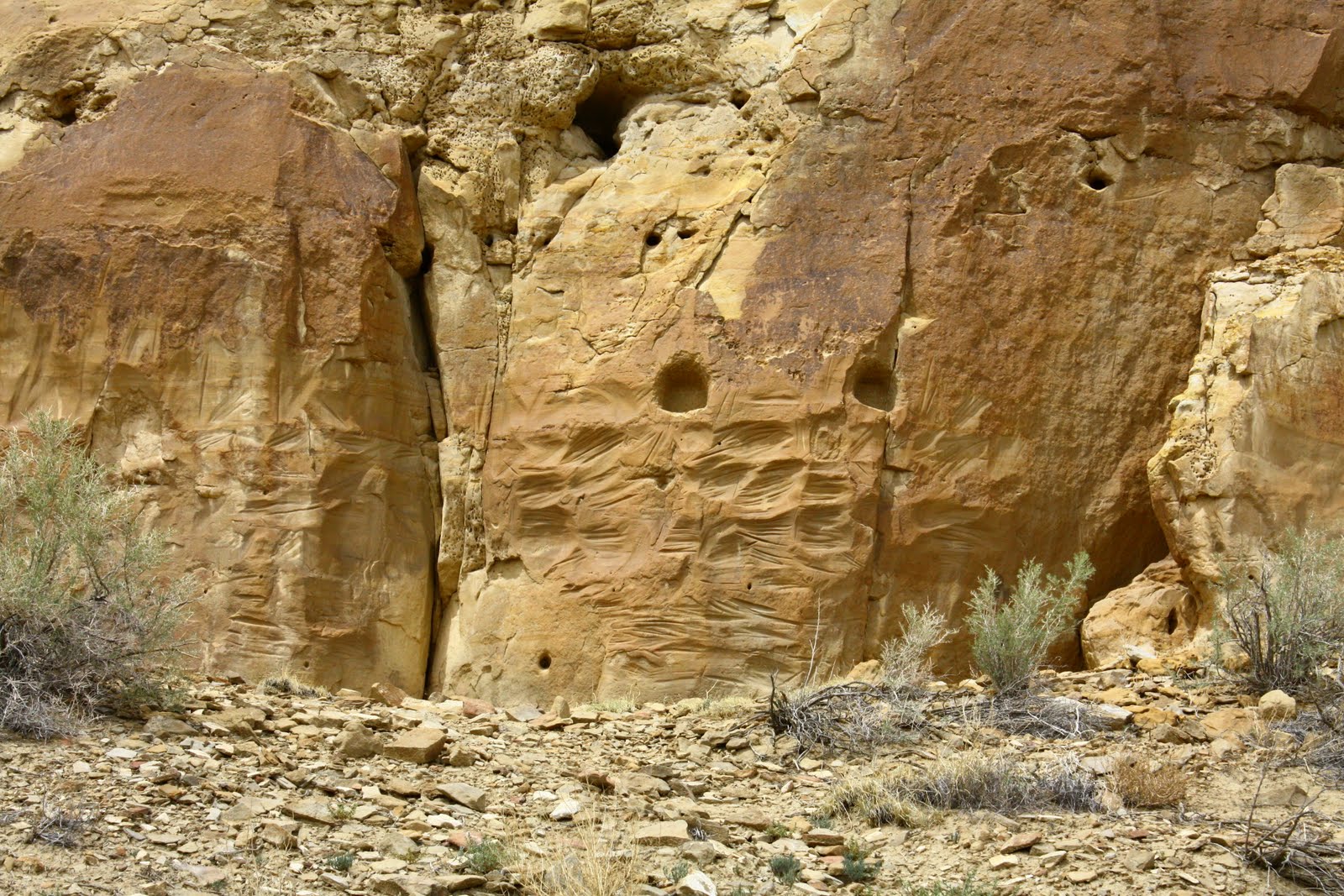
These petroglyphs perplex me. The holes apparently held a bench at one point, probably for astronomical tracking, as the sun rises on the right side of this photo and sets as it falls through the canyon on the left. However, the things that look like clawmarks are unlike any petroglyphs I have ever seen...
Detail of the "claw marks." One suggestion in the pamphlet for the "petroglyph trail" was that these might've been used as tool sharpeners. However, I don't like this interpretation because on this same wall is carved hundreds of sacred markings, and is located right behind/between pueblo bonito and chetro ketl, obviously a sacred spot.
Bricked up door at pueblo bonito. Apparently, when these folks left, they closed the passageways in some form of sacred ritual practice. I would also like to note that some of these pueblos in the canyon lie only a mile (on average) apart, giving rise to the idea that they were used more for sacred practices than simply for everyday living.
I liked this room in pueblo bonito. Notice the diagonal window/doors at the top left and right.

This picture does it no justice...I'm serious...Pueblo bonito is freaking huge!
Pueblo Bonito.
Grinding stone at Pueblo Bonito.
One of the great kivas at Pueblo Bonito. Notice the deflector behind the firebox in the center (used for light manipulation.) These things were covered with wooden beams for roofing at one point, so the use of light through several holes in the sides and the deflector were of sacred significance. Truly magical if you ask me. To think of what went on in that room...
A smaller kiva at Pueblo Bonito. I liked the support columns in this one. I noticed a couple of these smaller ones at this site had six beams in each kiva. I assume there was some significance.
The great Kiva at Pueblo Bonito. Notice the holes in the sides of the walls. I'm not sure if these were meant for light manipulation or simply to hold timber supports for either benches or the roofs. Ask me later. :P
A dig that was underway on the NW side of Pueblo Bonito.
Again, no justice. This doesn't even show the outliers of Pueblo Bonito...the place is freaking huge!
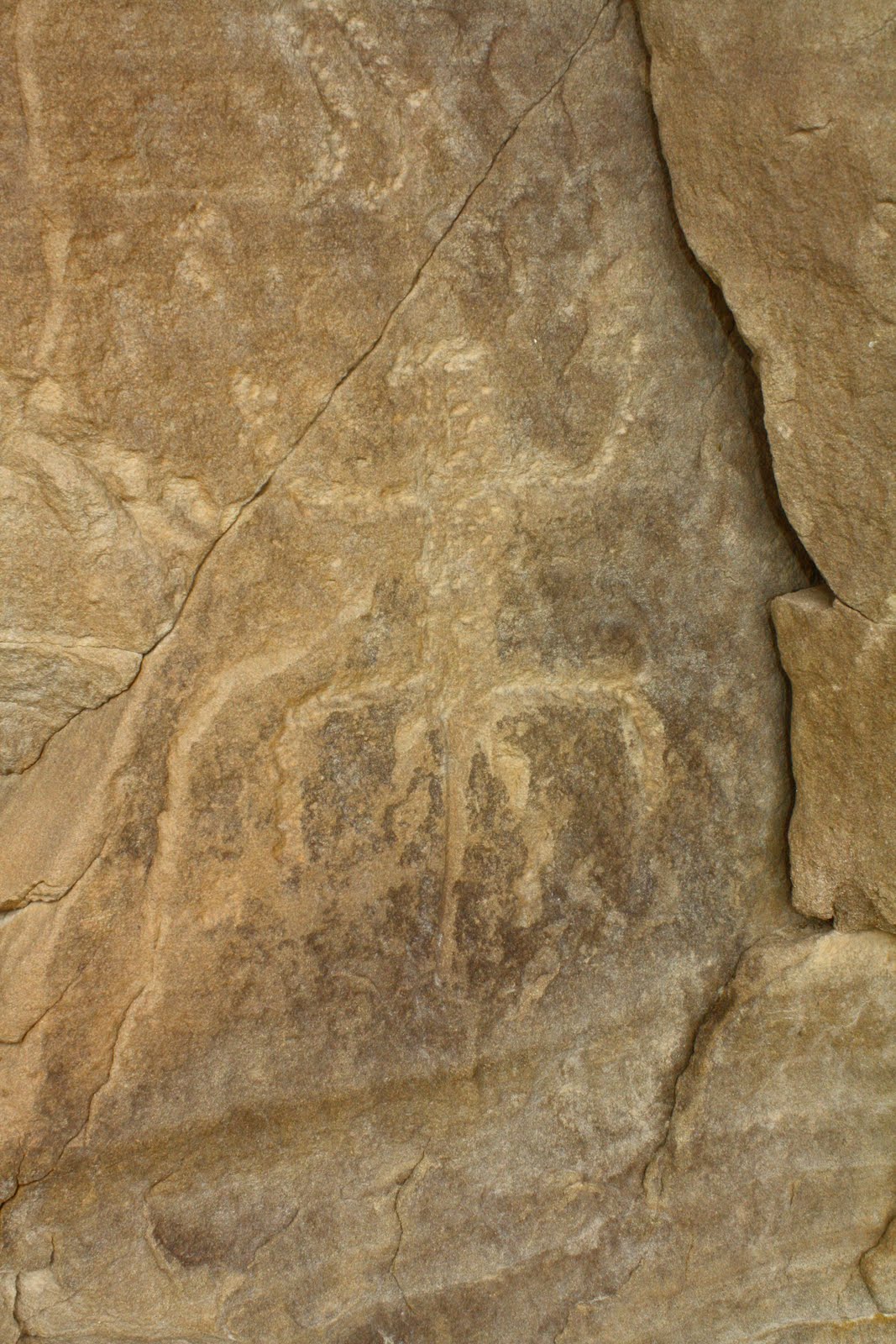
I wandered off the trail and found this petroglyph. :)
And alas, the famous "sun spirals" found throughout the canyon and of course, Native American rock art across the country. I learned different interpretations of these from people I talked to in New Mexico about Chaco. Some think they signify "sun watcher spots" but I am still led to believe that the spiral represents shamanistic assention/descention of power. But I haven't graduated yet, so... :P  
This one looks like some idiot has carved it out recently, or applied chalk to it. THIS is why there needs to be more education on rock art, especially in areas like the southwest where good preservation has left us with handfuls of sites.
I liked this little guy. Again, I found this one on my own, off the trail. :P
Cool, huh?!?! :D
Check out their heads. They're all different. This whole rock face, which extends the north side of the canyon is covered with stuff like this. Jack heaven. :)
This was about 20 feet in the air, so those folks must've had some pretty impressive ladders. I love the designs on this panel, though.
A historic image! Obviously of a railroad. There are several historic images of rock art in the park, but I thought this one to be especially cool. When I say historic, that simply means not-ancient. (To all you non-archaeological folks).
Peekaboo! :) Nice little shaman.
It was on a larger panel, but again, I see this as a shaman and a representation of his assention/descention into the spirit world. Any other suggestions?
This is the entire panel.
Lizard monster on the way to the Supernova Pictograph.
And yes, there are cactuses in the canyon. After my trip last year, I thought cacti to be merely elusive critters of fiction and legend, but no, they actually do exist in the desert. :P

Finally, after a three mile hike into the canyon by myself, with no food, I forded a fast-flowing, muddy, two-and-a-half-foot deep river 'til I found this supernova pictograph. This image has been featured in numerous books that I've studied, one that particularly comes to mind is Painted Dreams, by Thor Conway. Carol Diaz-Granados, the famous rock art researcher that is reviewing my paper has also mentioned some correlations to the explosion of 1054 in the rock art of Missouri, so it seems this event was of great spiritual significance within the realm of the natural world to the indigenous people of the Americas as it is clear these images seem to pop up around here and there. There is documented evidence from Chinese astronomers that the supernova explosion took place around July 2, 1054 and would've appeared as a "second sun in the sky" for quite some time. This obviously represents the light from the supernova (left) while the moon was present (right). And I assume the handprint (based on prior research in other parts of the country) has something to do with the shaman or artist that painted these images.
I liked these three. Notice the shaman on the left and in the middle are women.
Another historic petroglyph of a horse (from the Spanish conquests) and a railroad track. This was obviously created later by the Zuni or Navajo, or maybe even the Apache...I'm not really sure who was living in the area around the high-time of railroads in the west...
Preservation/reconstruction work at Pueblo del Arroyo. I thought this was cool.
Several small kivas at Pueblo del Arroyo.
Gazing at Fajada Butte, trying to see the elusive Sun Dagger rocks. There are three rocks placed high up on the Butte by the Chacoans that lie in front of a spiral petroglyph. On different days of the year, particularly the solstices and equinoxes, a beam of light shines through the three rocks and moves its way down through different parts of the spiral (during the summer solstice, the light pierces through the middle of the spiral.) Amazing archaeostronomical work by Ana Solfer, the leader of the solstice project has documented much of the rock art in the canyon and found many solar and lunar alignments to these sites. They have discovered amazing correlations to the placement of the pueblos and the movement of the sun and moon, some of the patterns taking hundreds of years of tracking by the ancients to correctly document. Fortunately for Solfer and others involved with the solstice project, computer technology has given us the ability to see these correlations in a matter of hours. There has been amazing work done in Chaco canyon, and it is truly a magical, magical place. :)
On the way out, took a picture of the sign. If you look to the top of the Butte on the right, you will see a small rock poking up. This is part of the sun-dagger site.

This little guys was waiting to say "hidy" on my way out of the canyon.

They weren't joking. It was the craziest road I've ever been on.
If you can imagine speed bumps every two inches, than you'd have this road. That's how you get in and out of the canyon, though, and even though driving into/out of the canyon was one of the scariest experiences of my life, I would love to return again someday and study further the ancient people that lived in Chaco canyon. :) 
I took over 300 pictures of the canyon and its rock art. Not all of those are featured on here. I'd be glad to show any and all of you all of the images, though...as this was only a handful of its amazingness. :) Be sure to check out my blog on Arizona...I should be posting tonight or tomorrow!

Life is good. Peace be with you all.